Showing posts with label palace. Show all posts

Sunday, 26 June 2016

Venturing into the Alpine-Carpathian Zone - Stop 2: Vienna

Vienna............. again, a very orthodox destination. The once powerful centre of the Habsburg monarchy, is rich with imperial history and, at the same time, has many interesting museums - including contemporary art museums.


It is a city of music - Mozart, Haydn, Schubert, Beethoven, Johann Strauss and many others...

The Opera House

It is a city of psychoanalysis. Sigmund Freud - he qualified as a doctor of medicine in 1881 at the University of Vienna. (Totally random...lol) 

It is a city of architecture - there are diverse architectural designs: Romanesque, Gothic, Renaissance, Baroque, Rococo, Art Nouveau, Classicism and Revivalism (or Historicism).

The Austrian Parliament is on the far left. It is of Classicism architecture. Classicism architecture incorporates Greek elements. The parliament was built in that design to signify democracy (Greece the birthplace of  democracy).
In front of the Hofburg Palace, at Michaelerplatz, you can see the different architecture designs of the buildings surrounding the roundabout.

The Baroque Hofburg Palace
Katholische Kirche St. Peter
St. Stephen's Cathedral - Medieval Roman Catholic Church

Kunsthistorisches Museum


Vienna is a city that boasts both ends of the spectrum - the modern, contemporary architecture designs contrast and fuse with the historical ones. Like the MuseumsQuartier - a modern museum architecture integrated into a space created around former stables for the Habsburgs' horses.


I found Vienna a bit 'all-over-the-place'. It was previously a small city developed around the Hofburg Palace. The city soon became overpopulated and hence, the city expanded (but in a disorganised way - I feel).

The two things from Vienna that stuck with me are:
1) Schönbrunn Palace: a Baroque palace - the former summer residence of the Habsburg monarchs


Vast garden with The Gloriette (the gate on the hill) in view. I love the gate - so regal.
Fountain in the garden

View from the hill near The Gloriette


2) Empress Elisabeth of Austria (also known as 'Sisi'):

  • The wife of Emperor Franz Joseph I, and thus Empress of Austria, Queen of Hungary and Queen consort of Croatia and Bohemia. 
  • She was a 'tortured' soul - she got married at the tender age of 16 into royalty - whereby she couldn't stand and sort of rebelled against the formal Habsburg court life. 
  • She was of the opinion that we are meant to be free and not be constrained by rules/ formality. Things got worse when her son died. She then isolated herself, wore black all the time and kept away from her husband even! 
I sometimes feel I resonate with her (I am sort of rebellious but NOT a tortured soul for sure! :D). I feel we are meant to be free - explore and learn from life as much as possible. We shouldn't be constrained by society's beliefs or 'run the corporate mill' for years! I truly admire and respect my parents - I mean, how did they do the same thing for 30 over years of their life and have no complaints! I was 3 years in, and couldn't bear it. It triggered me to search for the purpose of life! Lol

Sisi began writing poems as a young girl - some romantic and some sad. Here's one of Sisi's poems for you to get a glimpse of what she was like:
"Oh swallow, give me your quick wings
And take me with you to distant countries.  
I'll be happy to break the chains that hold me
And to break the bars of my prison ...
If I could fly with you
Through the blue eternity of heaven
How I would make thank you with all my being
The Goddess that men call freedom!"
Now, in this central region of Europe, the food eaten are mainly meat (& sausages!) and pastries. I think my body had to produce more insulin, throughout the whole trip, to keep my blood sugar levels low. Khuns, my travel partner, couldn't even stand the sight of the pastries mid-way through! Lol..

The Viennese Apfelstrudel (Apple strudel)

Esterházy torte

Croissant (this is the almond croissant)


An interesting fact: the croissant, which we thought is French, is originally from Vienna! Marie Antoinette, the Archduchess of Austria, brought the Viennese croissant to France upon her marriage to Louis XVI of France (French royalty) and moved to Versailles. Something unlearnt and relearnt!

You can find fish too - but river fish (not sea fish). I love fish, but not the river ones - I find them really 'fishy' (if you know what I mean!)

There is more to Austria than Vienna - Salzburg, Innsbruck, Hallstatt, Graz and many more, where I want to eventually leave my footprint. A 6-month road trip around Europe perhaps? Lol

From Vienna, we boarded the train to the obscure, appealing and cool Budapest!

Auf Wiedersehen in Wien! Helló Budapest!

Sunday, 12 June 2016

Finding Spirituality in Indonesia - Stop 2: Yogyakarta (Day 2) - Daytripping

Yogyakarta (sometimes pronounced as 'Jogjakarta' or 'Jogja'), in Central Java, is the soul of Java. It is the artistic and intellectual heritage centre of the Java island. It still holds strongly to its cultural heritage despite urbanisation.

Yogyakarta is the hub of art and education and also offers some good shopping. It is a popular tourist destination due to its proximity to Borobudur and Prambanan (more about that in the next post).

Batik - one of the main artistic heritage of Yogyakarta


Drawing the design of the Batik
Batik is a traditional heritage in both Indonesia and Malaysia. However, the designs are very different. The Malaysian design has more floral motifs and it is designed on softer silk, whereas the Indonesian on has more isen motifs, on silk, as well, but on stiffer silk.

Unlike other parts of Indonesia, Yogyakarta is still headed by a sultan (king). the Sultanate of Hamengkubuwono has ruled since 1755. Sultan Hamengkubuwono IX played a major role in Indonesia's independence from the Dutch. During the Indonesian war of independence, Sultan Hamengkubuwono IX offered Yogyakarta as the capital city to the fledgling Indonesian government. Hence, Yogyakarta became the revolutionary capital city of Indonesia from 1946 to 1949 when Jakarta was still occupied by the Dutch. He was also heavily involved in the independence negotiations.

Due to this, the central government recognized the Sultan of Yogyakarta as the appointed governor of Yogyakarta Special Region; the only one in Indonesia that is not elected directly by the people. The Indonesian central government has tried to weaken the sultan's power by calling for direct election for the governor, however, the people of Yogyakarta love the sultanate and the present Sultan Hamengkubuwono X was chosen by an overwhelming majority.

Whilst in Yogyakarta, do visit the palace where the Sultan still resides in. It is very unlike European palaces.


The palace is very typical Asian - a courtyard with buildings surrounding it.

Indonesia (and most of the Malay Archipelago) was founded by South Indian influenced kingdoms, (Srivijaya, Shailendra, Mataram, and Majapahit) which brought along Buddhism and Hinduism, from 7th century CE to the late 13th century, before the influence of Islam.

What I like about Indonesia is that they treasure and cherish their Buddhist, Hindu, and Islamic influences and assimilate them into their rituals, everyday lives and the palace even - although the majority are now practising Muslims. One example: the carvings in the palace have a blend of Buddhism, Hinduism, and Islam.

Gamelan and Wayang Kulit performance area


Another example: till this date, the Indonesian Wayang Kulit (traditional puppet-show) is about Ram and Sita (from Hindu mythology).

They know how to separate culture from religion... #justsaying!

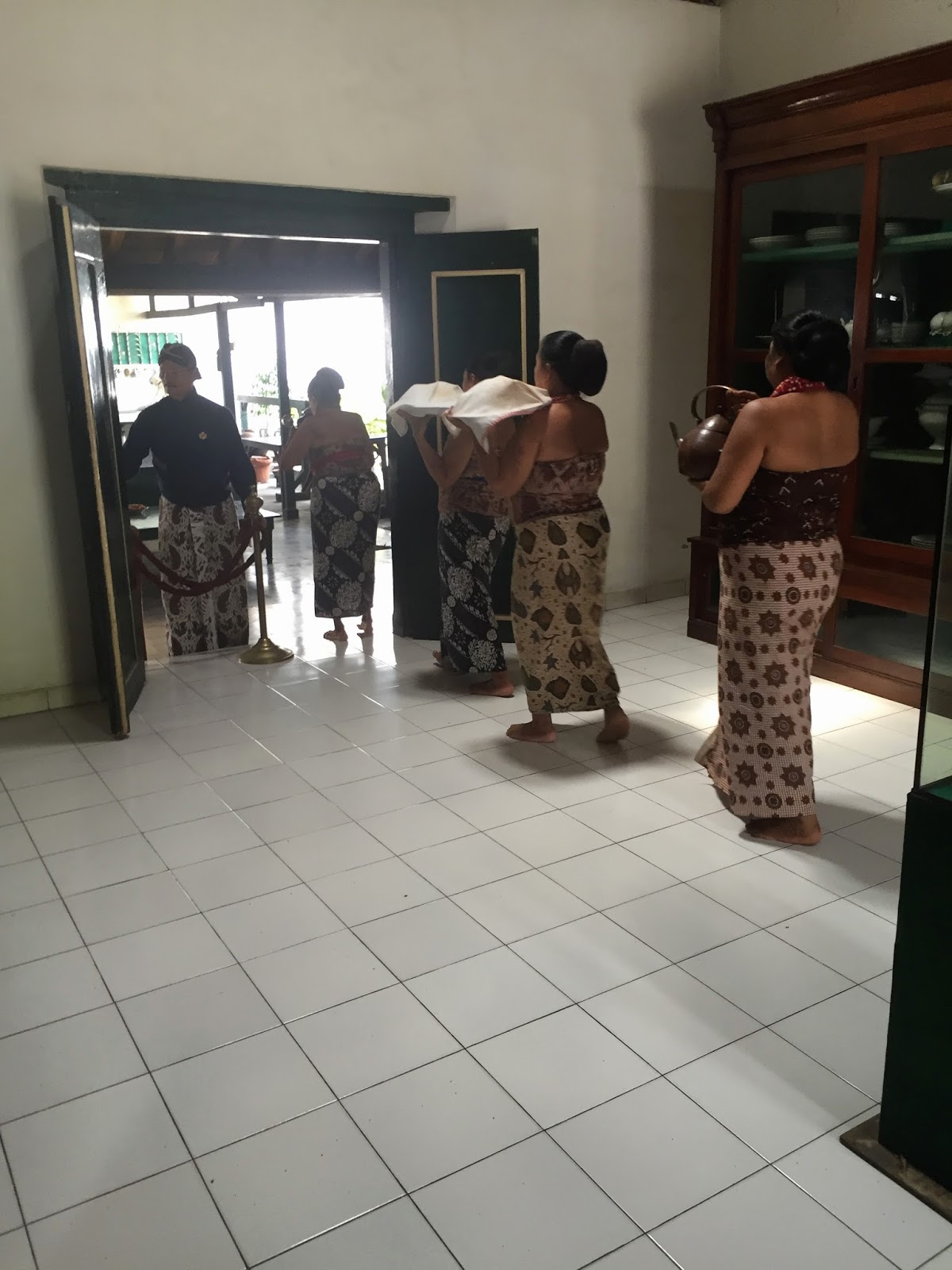
During our visit at the palace, we were lucky enough to witness the main tea-serving ceremony. This tradition has carried on till this date! Tea is served to the sultan and his wife at certain timings, throughout the day, every day! The main tea-serving ceremony takes place at 11am.

The 'head tea lady' carrying the teapot
To serve the sultan

The 'tea-lady' in the traditional outfit
The Yogyakarta palace is a great place to witness these traditional rituals and the traditional way of life, in this modern-day and age!

Hungry from all the exploring? Food time!

When one thinks of Indonesia, in terms of food, one thinks of a lot of meat and sambal (Asian chili pesto). However, my aunt and I found food paradise at Milas - a vegetarian restaurant serving local Central Javanese dishes, in a peaceful and lush surrounding.


I honestly had the best food here - during my entire trip! Central Javanese food is known to be a bit sweet - which I absolutely despise! At Milas, however, it is not!

Brown rice with tempe (fermented tofu) and sambal aubergine/ eggplant/ brinjal

Gado-gado (Indonesian salad served with peanut sauce)

They also serve exotic blends of smoothies (like avocado and lime smoothie) and traditional herbal drinks (like the turmeric and tamarind drink).

Other than the food and drinks, I love the 'hippe-esque' ambience. The people running Milas are also into organic items and saving the environment. Double love!

I recommend, for both meat lovers and non-meat eaters, to have lunch in this restaurant whilst in Yogyakarta. It is truly a treat!

If time is on your side, do explore and soak in the heritage of Yogyakarta!

See you in Prambanan.....


Saturday, 4 June 2016

Portuguese Voyage - Stop 4: Sintra (Days 12 & 13) - In a Fairy Tale

Romantic, magical, mythical. These are the words I would use to describe Sintra.

A hill station located 40 minutes north-west of Lisboa, whereby you can catch a train from Lisboa's Rossio train station to reach it. Most people visit Sintra for a day, but I highly recommend you spend two days (stay one night) in Sintra to fully draw in the magnetism, that is Sintra.

On the way from Sintra train station to the Sintra city centre

Palace of Sintra

When one thinks of Sintra, one thinks of Palácio da Pena (Pena Palace), which means Feather Palace in English (it certainly is as 'flamboyant' as a feather!) You can take a bus up to the palace from the Sintra city or hike up. I chose to hike up, which is an approximate 40-minute hike.

On the way up


When I read of woods in storybooks, this is exactly what I imagined - green and lush! I felt I was in Wonderland with Alice... lol.

When I finally reached the ticket counter, I was relieved, thinking the palace is just there. BUT from the ticket counter, there is another 1 km walk up to reach the palace! Nevertheless, the walk up is picturesque...


...and when you reach the palace, it is all worthwhile!

Palácio da Pena (Pena Palace)
The palace was commissioned by Ferdinand August Franz Anton from Austria, who married into the Portuguese royal family and became King Ferdinand II. King Ferdinand II wished to build a castle to rival the Neuschwanstein Castle in Bavaria. His only instruction was that the palace should reflect an opera - the palace surely is dramatic!


The palace is a prominent expression of late 18th century/ 19th-century Romanticism in the world.

*Romanticism - is an artistic, literary, and intellectual movement that originated in Europe toward the end of the 18th century and was at its peak in the mid-19th century. Resulted partly from the libertarian and egalitarian ideals of the French Revolution, and partly a reaction to the aristocratic social and political norms of the Age of Enlightenment and the scientific rationalisation of nature. Romanticism emphasised individualism, subjectivity, irrationality, imagination, spontaneity, emotions, personality, the visionary, and the transcendental.*


The palace has a mixture of different architectural styles: Gothic, Manueline, Islamic, and Renaissance - in accordance with the extravagant style of Romanticism.


Gargoyle - symbolising the creation of the world


There is so much to explore in the palace and its surrounding grounds. I wonder, why hasn't this palace been featured in any movies, or why are there no fairy-tale palaces based on this unique palace?

Just a 5-minutes walk from the palace is the Castelo dos Mouros (Castle of the Moors) - a medieval castle perched on top of Sintra Mountains, overlooking Sintra city.


View of Sintra city
The castle was constructed during the 8th and 9th centuries, during the period of Muslim Iberia. It was taken by Christian forces from the Moors after the fall of Lisboa.

The entrance

Walk towards the castle


The castle


View of the surrounding estates from the castle
You can also see the Palácio da Pena (Pena Palace) from the castle.


Majestic and fairy-tale like

Equally as resplendent as the palace, and somewhat spiritual, is the Quinta da Regaleira. The Quinta da Regaleira is located in the Sintra city area - hence, no hiking needed :D

The Romantic Regaleira Palace
The estate is like a treasure hunt - there are so many things to discover: lakes, wells, grottoes, fountains, and other fascinating constructions.


The famous Initiation Well
The well never served as a water source. Instead, it was used for ceremonial purposes that included Tarot initiation rites.

Passage in the well

Threshold of the Gods

Threshold of the Gods

The gardens with the chapel in view

Chapel
There is an extensive and enigmatic system of tunnels, which have multiple entry points that include: grottoes, the chapel, Waterfall Lake, and Leda's Cave. The Initiation Well connects to other tunnels via a series of underground walkways. Mysterious much?

There was so much thought put into the details of the palace as well.

Door knob

Fireplace

View of the garden

Palace walkway


Why do I say it is spiritual? In addition to the Tarot initiation, the design of the palace and the surrounding gardens were meant to signify the transition from dark to light. For example, the tunnels - moving from dark to light (bad energy to good energy, evolving to a higher spiritual state).  

A passage found on one of the walls in the Regaleira Palace
No wonder I have an affinity for this place - it is so me! (I am into all these 'energy', spirituality kind of thing. Yes, I am a quack! Lol)

*All three sights are classified as UNESCO World Heritage Sites.*

Am I right to say Sintra is mythical? :D

If you stay the night, you can take a bus to Cabo da Roca to catch the sunset. The bus ride is about 30 minutes. Cabo da Roca is the cape which forms the westernmost area of continental Europe.

View from the bus on the way to Cabo da Roca


Deeply serene!

*Please note that the last bus from Cabo da Roca to Sintra is at 8.10pm. Plan your visit accordingly so you can spend more time at Cabo da Roca.*

Now, on to the food - more like pastries :D! When in Sintra, please do savour the Queijada de Sintra (Sintra Cheesecake) and the Sintra Travesseiros (means pillow in English), at none other than the Pastelaria Piriquita.

Pastelaria Piriquita
The Queijada de Sintra is not the typical American cheesecake. It is made with fresh cheese and has a noticeable cinnamon flavour - a reflection of Portugal's Moorish past. It reportedly dates back to the 13th/ 14th century.


The Sintra Travesseiros is a flaky pastry stuffed with almonds, egg, and sugar paste - the pastry is so soft that it melts in your mouth! Scrumptious! (The pastry reminds me of the Chinese pancake.) 


Having these, fresh out of the oven, with meia de leite, after a long day of exploring and hiking - BLISS!

Sintra city

View of Castelo dos Mouros (Castle of the Moors) from Sintra city

Alleys of Sintra city

Before you leave Sintra, do have lunch at the unconventional and the rather kitschy Café Saudade.


The café has some history attached to it

The café is located near the Sintra train station. I love the 'I want to save the world', hippie vibes, the café exudes. The food is delectable too! 

Tasca platter (comes with olives, sardines, queijada and a glass of wine)

It took me a while to leave this alluring city. After 2 days in Sintra, I took the train back to Lisboa, to fully revel in Lisboa for the night, before flying off to Madeira the next morning, in hopes of meeting Cristiano Ronaldo...lol.


 Vamos para a Madeira!