Showing posts with label Yogyakarta. Show all posts

Monday, 13 June 2016

Finding Spirituality in Indonesia - Final Stop: Prambanan (Day 3) - The Overshadowed Shrine

You can easily associate the Borobudur with Buddhism. Like Buddha, it resembles prosperity and it is well-rounded...

Prambanan, on the other hand, is slender and taller in shape, in accordance with Hindu architecture.


I find it more prepossessing than the Borobudur temple.


It is the largest temple complex on the Java island, with three main temples dedicated to the three great Hindu divinities: Brahma (the creator), Vishnu (the preserver/ maintainer) and Shiva (the destroyer). The main temple is dedicated to Shiva. The destroyer! Why?

It is believed that there needs to be destruction to make way for new life. (Trump the modern-day incarnation of Shiva? HELL NO!)


Lord Shiva
The Shiva shrine is the main shrine with 4 chambers. One with a statue of Lord Shiva. The other 3 chambers contain statues of Hindu Gods related to Shiva; his wife Durga, the sage Agastya, and Ganesha, his son.

Lord Shiva's shrine
According to history, Rakai Pikatan, a Hindu prince from Sanjaya Dynasty, who had married into the ruling Buddhist Sailendra dynasty, built all the temples in the Prambanan complex, in the 8th century AD. Originally, the temple complex contained over 250 large and small temples. 

It was then expanded by successive Hindu Mataram kings, who defeated the Sailendra kingdom, with the addition of the hundreds of perwara temples around the central temples. The temples collapsed during a major earthquake in the 16th century. 


The rubble from the earthquake. The other smaller temples are slowly being restored till this date.

There is another local legend, known as Roro Jonggrang, which tells the tale of how the Prambanan complex was built. Bondowoso was in love with Roro Jonggrang and asked her to marry him. However, Roro Jonggrang was full of hatred because Bondowoso killed her father; hence, she tried to refuse his proposal by asking him a seemingly impossible task of building a thousand temples and two wells in one night. However, as a man who had an unseen troop of spirits, it was easy for Bondowoso to finish the task. After completing his 999th temple, Roro Jonggrang asked the villagers to pound rice and to set a fire in order to look like the morning had broken - in an attempt to thwart Bondowoso’s effort. Bondowoso realised that she had cheated him so he turned Roro Jonggrang into the 1,000th statue. It is said the statue of Durga is the statue of the slender virgin Roro Jonggrang. The locals love to share this tale.

Lord Vishnu's shrine
The Hindu temples are decorated with reliefs illustrating the Indonesian version of the Ramayana epic which are masterpieces of stone carvings.

There is a museum within the Prambanan complex which describes the architecture of the temples and has some of the ruins/ carvings found during archaeological discoveries.


If you stay the night, you can watch the Ramayana ballet. During good weather, the dance is performed outside, with the Prambanan temples as the backdrop. However, during the rainy season, it is performed indoors.

Please note the 'ballet' is an Indonesian version. Not the classic Western ballet.

Ramayana is a Sanskrit tale, attributed to Valmiki, a poet, about the banishment of Rama (incarnation of Lord Vishnu) from his kingdom, the abduction of his wife, Sita, by Ravana (a demon) and her rescue, and Rama's eventual restoration to the throne. 

You may think Rama is the saint, but I certainly do not admire him! After rescuing her, he made Sita prove her purity by making her burn herself!! WTF!? Thank the heavens she left him after! Lol.... Also, we must hear Ravana's side of the story, why did he kidnap Sita in the first place? Watch the ballet, you may find out why and may have more respect for Ravana instead :)

Did I go home more spiritual than before? I don't know. I think so. To me, travelling is a form of meditation, it keeps you in the NOW - in the present moment. Based on this, I go home more enlightened than before, every time :)

Selamat Tinggal!

Sunday, 12 June 2016

Finding Spirituality in Indonesia - Stop 2: Yogyakarta (Day 2) - Daytripping

Yogyakarta (sometimes pronounced as 'Jogjakarta' or 'Jogja'), in Central Java, is the soul of Java. It is the artistic and intellectual heritage centre of the Java island. It still holds strongly to its cultural heritage despite urbanisation.

Yogyakarta is the hub of art and education and also offers some good shopping. It is a popular tourist destination due to its proximity to Borobudur and Prambanan (more about that in the next post).

Batik - one of the main artistic heritage of Yogyakarta


Drawing the design of the Batik
Batik is a traditional heritage in both Indonesia and Malaysia. However, the designs are very different. The Malaysian design has more floral motifs and it is designed on softer silk, whereas the Indonesian on has more isen motifs, on silk, as well, but on stiffer silk.

Unlike other parts of Indonesia, Yogyakarta is still headed by a sultan (king). the Sultanate of Hamengkubuwono has ruled since 1755. Sultan Hamengkubuwono IX played a major role in Indonesia's independence from the Dutch. During the Indonesian war of independence, Sultan Hamengkubuwono IX offered Yogyakarta as the capital city to the fledgling Indonesian government. Hence, Yogyakarta became the revolutionary capital city of Indonesia from 1946 to 1949 when Jakarta was still occupied by the Dutch. He was also heavily involved in the independence negotiations.

Due to this, the central government recognized the Sultan of Yogyakarta as the appointed governor of Yogyakarta Special Region; the only one in Indonesia that is not elected directly by the people. The Indonesian central government has tried to weaken the sultan's power by calling for direct election for the governor, however, the people of Yogyakarta love the sultanate and the present Sultan Hamengkubuwono X was chosen by an overwhelming majority.

Whilst in Yogyakarta, do visit the palace where the Sultan still resides in. It is very unlike European palaces.


The palace is very typical Asian - a courtyard with buildings surrounding it.

Indonesia (and most of the Malay Archipelago) was founded by South Indian influenced kingdoms, (Srivijaya, Shailendra, Mataram, and Majapahit) which brought along Buddhism and Hinduism, from 7th century CE to the late 13th century, before the influence of Islam.

What I like about Indonesia is that they treasure and cherish their Buddhist, Hindu, and Islamic influences and assimilate them into their rituals, everyday lives and the palace even - although the majority are now practising Muslims. One example: the carvings in the palace have a blend of Buddhism, Hinduism, and Islam.

Gamelan and Wayang Kulit performance area


Another example: till this date, the Indonesian Wayang Kulit (traditional puppet-show) is about Ram and Sita (from Hindu mythology).

They know how to separate culture from religion... #justsaying!

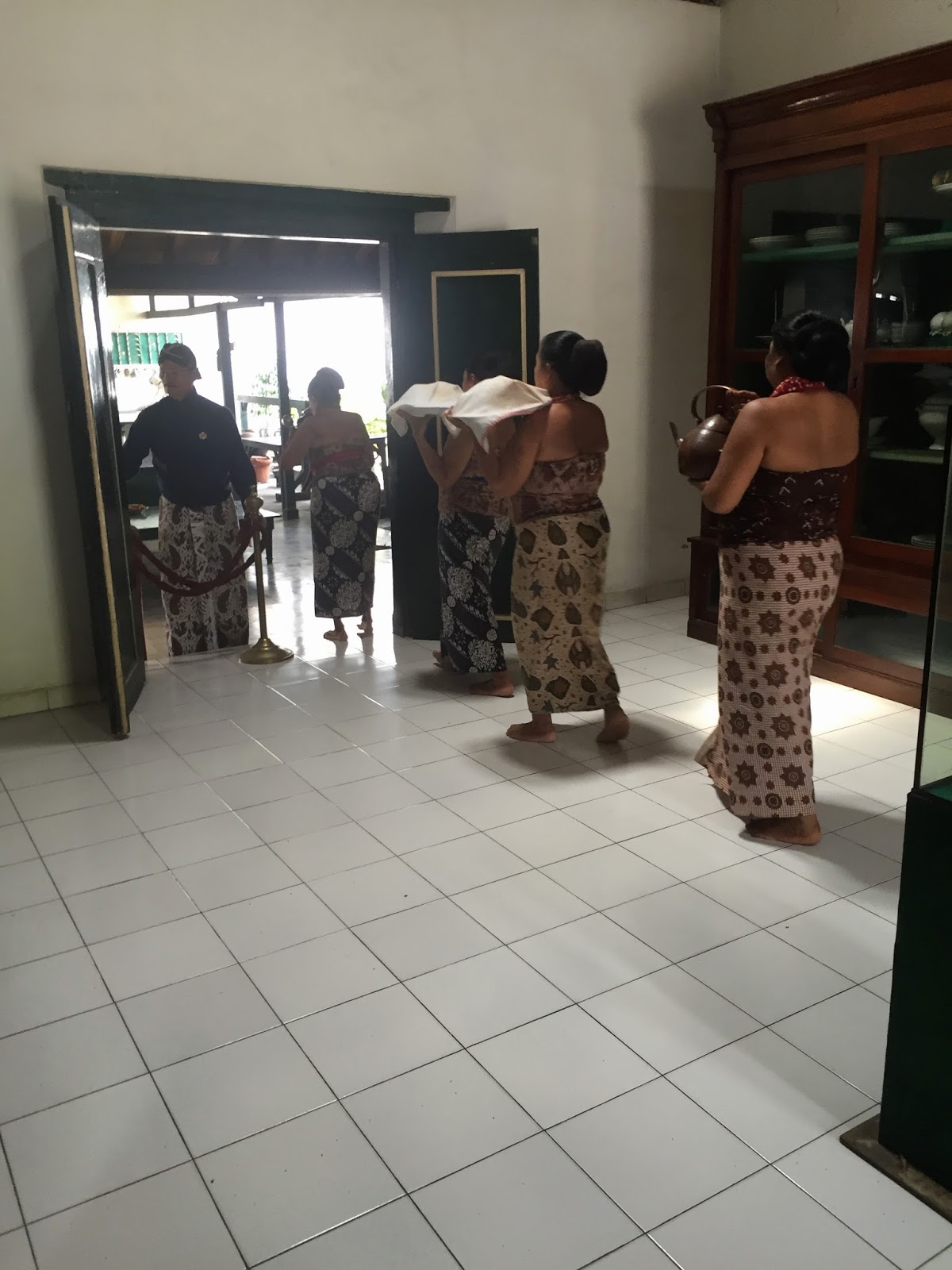
During our visit at the palace, we were lucky enough to witness the main tea-serving ceremony. This tradition has carried on till this date! Tea is served to the sultan and his wife at certain timings, throughout the day, every day! The main tea-serving ceremony takes place at 11am.

The 'head tea lady' carrying the teapot
To serve the sultan

The 'tea-lady' in the traditional outfit
The Yogyakarta palace is a great place to witness these traditional rituals and the traditional way of life, in this modern-day and age!

Hungry from all the exploring? Food time!

When one thinks of Indonesia, in terms of food, one thinks of a lot of meat and sambal (Asian chili pesto). However, my aunt and I found food paradise at Milas - a vegetarian restaurant serving local Central Javanese dishes, in a peaceful and lush surrounding.


I honestly had the best food here - during my entire trip! Central Javanese food is known to be a bit sweet - which I absolutely despise! At Milas, however, it is not!

Brown rice with tempe (fermented tofu) and sambal aubergine/ eggplant/ brinjal

Gado-gado (Indonesian salad served with peanut sauce)

They also serve exotic blends of smoothies (like avocado and lime smoothie) and traditional herbal drinks (like the turmeric and tamarind drink).

Other than the food and drinks, I love the 'hippe-esque' ambience. The people running Milas are also into organic items and saving the environment. Double love!

I recommend, for both meat lovers and non-meat eaters, to have lunch in this restaurant whilst in Yogyakarta. It is truly a treat!

If time is on your side, do explore and soak in the heritage of Yogyakarta!

See you in Prambanan.....


Wednesday, 8 June 2016

Finding Spirituality in Indonesia - Stop 1: Borobudur (Day 1) - Reverse Nirvana

Aunt,"Want to go to Borobudur?". Me, "Yes! Yes! Yes!"

Borobudur is the largest Buddhist temple dating back to the 8th/ 9th century. The venerable temple is located in central Java (an hour from Yogyakarta) and is an ancient site for pilgrimage and education in Mahayana Buddhism.

I have always been intrigued by the Buddhist teachings and Eastern philosophy. I feel it goes back to the basics of nature and it makes a lot of sense, even scientifically. Also, I felt I needed to re-align my cosmic energy (jokes!), hence the added excitement to 'do the pilgrimage'..hehehe


Borobudur was built during the golden era of the Sailendra dynasty, which held sway on Java and Sumatra. The Sailendra clan came from South India, but what is impressive is that Indonesian architectural elements were also incorporated into this august, South Indian influenced, structure.

Historians suggest that the name of Borobudur comes from the Sanskrit 'Vihara Buddha Uhr' which means ‘Buddhist monastery on the hill’.


There are more than 2,000 relief panels and 500 Buddha statues. There are 72 Buddha statues surrounding the central dome, each seated inside a perforated stupa. Borobudur has the largest and most complete ensemble of Buddhist reliefs in the world.


Relief panels - depicting tenets of Buddhism

Stupa


Stupa is a replica of the universe

Buddha in the stupa
The journey for pilgrims begins at the base of the monument and follows a clockwise path around the monument and ascends to the top through three levels symbolic of Buddhist cosmology: Kāmadhātu (the lowest level, the world of desire - influenced by negative impulses), Rupadhatu (middle level, the world of forms - in which man has control of his negative impulses and uses his positive impulses) and Arupadhatu (the world of formlessness -  the highest level, in which the world of man is no longer bounded by physical and worldly ancient desire).

As one climbs upwards from level to level, he/ she is guided by the stories and wisdom of the bas-reliefs from one symbolic plane of consciousness to the next, higher level on the journey to enlightenment.


My aunt and I decided to 'meditate' and watch the sunrise from the temple. We made our way to this sacred monument at 4am in the morning and climbed directly up to reach 'nirvana'... lol.

Around sunrise

Trying to meditate
The view from the top of the temple, at sunrise, is serene.


Surrounding mountains


As mentioned above, pilgrims start from the bottom of the monument and make their way clockwise to the top. My aunt and I started from the top and made our way down - in anti-clockwise! No wonder we are so out-of-place! Lol! (Reverse nirvana!)

The Borobudur Temple from a distance


So what do you do in Borobudur when you have the whole day ahead of you although, you have been awake for the past 7 hours exploring the largest Buddhist temple?.... Read the next post!


Jumpa nanti!